
Hem » Gamla testamentet (Sida 3)
Kategoriarkiv: Gamla testamentet
Childs, Introduction to the Old Testament – 4

Chapter 3: Canon and Criticism
In the third chapter Childs discusses “Canon and Criticism” under six subheadings: 1) Exegesis in a Canonical Context, 2) The Canonical Approach Contrasted with Others, 3) The Final Form of the Text and its Prehistory, 4) The Canonical Process and the Shaping of Scripture, 5) Scripture and Tradition, 6) Canon and Interpretation. The purpose of the chapter is to describe an approach that will attempt to overcome the methodological problems regarding the canon described by Childs in chapter 2. To fulfill this purpose Childs will “relate the canonical form of the Old Testament to the complex history of the literature’s formation.” Childs criticizes the historical critical method in the way it is dealing with the canonical literature of the Old Testament, but emphasizes also that the canonical approach it not a non-historical reading of the Bible. He says: “The whole point of emphasizing the canon is to stress the historical nature of the biblical witness.” [1]
When doing exegesis in a canonical context it is essential to maintain a theological relationship between the people of the Old Covenant and of the New – Childs means that the common canon of the Hebrew Scriptures is the basis for serious relationship. However in the third chapter Childs limits himself to the Hebrew Scriptures, and comes back to the broader issue of exegesis in the final chapter of the book. After having set these parameters, Childs explains that the major task of a canonical analysis of the Hebrew Bible is a descriptive one that focuses its attention on the final form of the text itself. Canonical analysis treats the biblical literature in its own integrity and studies the features of these texts (as records of God’s revelation to his people along with Israel’s response) in relation to their theological and religious usage within the historical community of ancient Israel. The canonical method is thus not an attempt to apply exterior dogmatic categories on the biblical text, but to work within the interpretative structure which the biblical text has received from those who formed and used it as sacred scripture.[2]
The crucial methodological issues concerning the canonical approach are outlined by contrasting it with other critical methods. Childs explains that the canonical study shares with several other literary critical methods the concern to do justice to the integrity of the text itself, but differs by interpreting the biblical text in relation to a community of faith and practice: “The canonical approach is concerned to understand the nature of the theological shape of the text rather than to recover an original literary or aesthetic unity.” The canonical method differs also sharply from the “kerygmatic exegesis”[3] in the sense that a theological point must not be related to an original intention in a reconstructed historical context, but rather to its function in the final form of the biblical text. The canonical study is also different from the traditio-critical approach in the way it evaluates the history of the text’s formation. Canonical study assumes the normative status of the final form of the text, while the traditio-historical criticism tries to recover the historical growth of the text. Childs feels that contrasting approaches are missing the mark and do not fully understand the canonical proposal.[4]
The canonical approach insists upon the final form of the Scripture, which reflects a history of encounter between God and Israel. The final form of the text alone bears witness to the full history of revelation. The witness of the experience with God lies not in the recovery of the historical process. It is only in the final form of the biblical text that the full effect of this revelatory history can be perceived. However, early stages in the development of the biblical text are important, thus to take the canon seriously also means to take the stages of formation seriously. The early stages aid in understanding of the interpreted text, and do not function independently of it. But Childs means that it is still the final form of the text that hermeneutically establishes the peculiar profile of a passage, and any method (e.g. Heilsgeschichte, the historical critical method or philosophical hermeneutics) which seeks to shift the canonical ordering must be resisted.[5]
The Hebrew canon was formed during a long period (beginning in the pre-exilic period) of time as an integral part of the literary process. Basic to this canonical process is that those responsible (editors [Hezekiah’s court], religious groups [Deuteronomic party of Jerusalem], political parties) for the editing of the text did their best to obscure their own identity. The consequence is that the actual process, and the original sociological and historical differences within the nation of Israel, was lost. Thus Israel emerged as a religious community with its identity in the sacred Scripture. One motivation behind the canonical process is that tradition from the past was transmitted in such a way that it would be authoritative and accessible to all future generations of Israel (Deut. 31:9ff.; Ex. 12:14, 26ff). This transmission was not merely a passive channeling of material from one generation to another, but reflects an active hermeneutic that shaped both the oral and written traditions, so that the tradition would not be fixed it in the past, but religiously accessible to future generations. Thus, Childs points out that because the historical critical method has disregarded the canonical shaping, it has found itself unable to bridge the gap between the past and the present. When “decanonizing” the biblical text the interpreter has difficulty applying it to the modern religious context.[6]
Childs explains that one of the most difficult problems of the canonical approach “involves understanding the relationship between the divine initiative in creating Israel’s Scripture and the human response in receiving and transmitting the authoritative Word.” If the active human participation is a necessary feature for correctly understand the text, what then is the relationship between the divine and human of the Bible, between scripture and tradition? Childs concludes, after having briefly reviewed the long and heated controversy (Roman Catholic vs. Protestants) within Christian theology, that “the canonical method is not tied to one narrowly conceived dogmatic stance respecting the problem of scripture and tradition. The approach seeks to work descriptively within a broad theological framework and is open to a variety of different theological formulations.” However, Childs explains that the canonical method runs counter to two theological positions: 1) the position that stresses the divine initiative and rules out the human response to the divine word as theologically significant, and 2) the position that understands the formation of the Bible as purely human (e.g. Israel’s search for self-identity).[7]
The approach that Childs have undertaken has been described as “canonical criticism”. Childs himself is not satisfied with this term, because that turns the canonical approach into another historical critical technique. Rather, Childs wants to establish a stance from which the Bible can be read as sacred scripture. Negatively this means a relativization of the historical critical method, and positively it challenges the interpreter to look at the biblical text in its received form and to discern its function for an community of faith. The canonical shaping draws the boundaries within which the exegetical task is to be carried out. The effect is two fold: 1) The canonical method sets limits on the exegetical task by taking seriously the traditional parameters; 2) The method liberates from the stifling effect of academic scholasticism. In sum, Childs says, “the canon establishes a platform from which exegesis is launched rather than a barrier by which creative activity is restrained.”[8]
[1] Ibid., 71.
[2] Ibid., 72–74.
[3] This method attempted to discover the central intention of a writer, usually by means of a formulae or themes, which intention was then linked to a reconstruction of a historical situation which allegedly evoked that given response.
[4] Childs, Introduction to the Old Testament as Scripture, 74–75.
[5] Ibid., 75–77.
[6] Ibid., 77–79.
[7] Ibid., 80–82
[8] Ibid., 82–83.
Childs, Introduction to the Old Testament – 3
Chapter 2: The Problem of the Canon
In the second chapter Childs deals with “The Problem of the Canon” from seven perspectives: 1) Terminology; 2) The Traditional View of the Canon and its Demise; 3) The Nineteenth-century Historical Consensus and its Erosion; 4) The Search for a New Consensus; 5) A New Attempt at Understanding Canon; 6) The Relation between the Literary and Canonical Histories; 7) A Sketch of the Development of the Hebrew Canon.
Childs begins this chapter with the question: “What is meant by ‘the canon’? However, the real problem with defining this term is not settled by philological evidence. History of interpretation shows how different the concepts of canon have been over the centuries and Childs states that the reason for the present confusion over the problem of the canon is because of the failure to reach an agreement regarding the terminology.[1]
Old Testament itself does not directly explain when and how the history of canonization took place. Still various Jewish traditions developed during the Hellenistic period that was accepted by both Jews and Christians until seventeenth century. Elias Levita developed the theory that it was men of the Great Synagogue under Ezra who established the canon of the Hebrew Bible and divided it into three parts. This theory was accepted by Jews and Christians until the end of nineteenth century. The traditional viewpoints varied but they had in common an underlying assumption of an unbroken continuity between writing and collection authoritative scriptures until the last book was written and the canon was closed. This traditional understanding of the canon eventfully collapsed because of attacks from critical research, which questioned the accuracy of the traditional concept of the canon’s history.[2]
This new critical theories of the canon from a strictly historical perspective (Eichhorn, Corrodi, de Wette, and others) failed however to achieve wide consensus, because of the disagreement over the history of the literature. But the growing dominance of Wellhausen’s reconstruction of Israel’s history and literature developed a new consensus regarding the history of the canon. Therefore the classic literary critical construction of the formation of the canon continued, with some modification, to be represented in Introductions (Pfeiffer, Bentzen, and Eissfeldt).[3]
This nineteenth-century classic reconstruction of the history of the canon has however according to Childs in turn seriously eroded in several ways: 1) Most of the historical points upon which the theory was built on seem no longer able to bear the weight placed upon them; 2) The assumption that the Masoretic division of a tripartite canon was the original order reflecting three historical stages, and that the Septuagint’s order was a later adjustment, has been questioned; 3) The recovery of a sense of oral tradition which criticized the literary critical school for identifying the age of the material within a book with its literary fixation.[4]
Because of this erosion in the classic critical reconstruction new attempts was made in an effort to form a new synthesis. The characteristics of these efforts are sketched out by Childs by referring to five scholars who represents five views of the development of the Old Testament Canon. They are G. Hölscher, David Noel Freedman, Z. Leiman, M. G. Kline and A. Sanders. Childs summarizes his analysis of these efforts by explaining that the task of assessing the role of the canon in understanding the Old Testament has proven to be an enormously difficult problem. Its terminology, history, and function remain highly controversial. Childs thus concludes that up to the point of the publishing of his own Introduction “no fully satisfactory new interpretation has been able to achieve a consensus”.[5]
Childs feels it is now time to formulate a new definition of the term canon. He begins with the criteria of such a definition: 1) It has to do justice to all the dimensions of the issue and be consistent in application; 2) It has to contain both a historical and theological dimension of process and reflection; 3) It has to avoid a too sharp separation between the authority of writing and its canonization. Thus, according to Childs, the term canon has both a historical and theological dimension, which involved a series of decisions that shaped the books. It involved a “profoundly hermeneutical activity” that was built into the structure of the canonical text. This activity consisted of Israel’s response too and understanding of divine scripture. The heart of this process is the transmission and ordering of “the authoritative tradition in a form which was compatible to function as scripture for a generation which had not participated in the original events of revelation.”[6]
To further understand the canon of the Hebrew Scriptures one has to study its history of literary development, which shares in general many features with Near Eastern literature. In this discussion Childs is critical too how different scholars have tried to identify the literary and canonical histories. He means that these two historical processes are not to be identified, but they belong together. What follows are Childs’ general observations regarding the relationship: 1) The development of Hebrew literature involved a much broader history than the history of the canon’s development; 2) There were periods in the history of Israel in which the canonical history was largely subsumed under the history of the literature’s development; 3) Because of the lack of historical evidence, it is extremely difficult to determine the motivations involved in the canonical process. Childs conclusion concerning the relationship is: “Caution must be exercised not to hypothesize the history of the literature’s growth in such a way as to eliminate a priori the religious dimensions associated with the function of the canon.”[7]
Childs says that Deut. 31:24ff records an early stage in the growth of the canon of the Law. This “Deuteronomic description” has a close relationship with earlier tradition. Concerning the canonical history of the Prophets, scholarly opinions differ because of insufficient evidence. Childs criticizes different positions regarding the canon of the Prophets, and points to different signs of canonical development from both the pre- and post-exilic period. Also, according to Childs, there are signs of mutual influence between the Law and the Prophets, which shows that the canonical process of these two sections was not isolated from each other. The evidence regarding the Writings is sparse and contested. But Childs means that in spite of lack of evidence for dating and closing the third section, the stabilization of the Hebrew text by the end of the first century AD point to a rather closed Hebrew canon by the beginning of the Christian era. Finally, the canonization process involved a selection of a limited number of books from a much larger group of literature. The motivation behind this narrowing process is much debated, but Childs does not attribute this process to an anti-Christian move.[8]
Childs concludes so far that 1) there was a genuine historical development involved in the formation of the canon, and 2) the available historical evidence allows for only a bare skeleton of this development. The implications drawn from this is that “the history of the canonical process does not seem to be an avenue through which one can greatly illuminate the present canonical text.” Childs thus wonders if there is any way out of this deadlock.[9]
[1] Ibid., 49–51.
[2] Ibid., 51–52.
[3] Ibid., 52.
[4] Ibid., 52–54.
[5] Ibid., 54–57.
[6] Ibid., 57–60.
[7] Ibid., 60–62.
[8] Ibid., 62–67.
[9] Ibid., 67–68.
Fragment från Aleppo kodex återlämnad
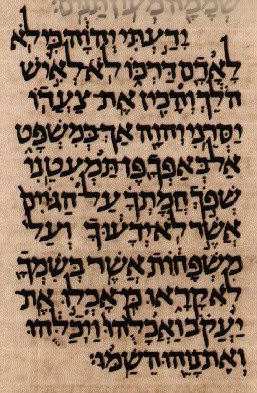
Det finns många fascinerande (och spännande) berättelser om hur bibliska textfragment och manuskript har upptäckts, spårats eller överlämnats till forskare. Ett av de mest kända exemplen är Dödahavsrullarna. Boktips om den berättelsen är den populärt skrivna boken The Mystery and Meaning of the Dead Sea Scrools av Hershel Shanks (Random House, New York. 1998). En riktig thriller faktiskt.
Nu skall ett fragment från Aleppo kodex (”Toras krona”, se bild ovan) återlämnas till forskare. Aleppo kodex huserade i Mustaribah synagoga i Aleppo, Israel, från 1478 till december 2 1947, när synagogan skadades svårt av brand under upploppen mot judarna efter det att FN röstade för att etablera staten Israel. Kodexen räddades mirakulöst ur askan och hamnade i Jerusalem, i Hebreiska universitetet. En fjärdedel av sidorna förstördes i branden.
Det speciella och betydelsefulla med införandet av kodex i spridning av Gamla testamentet, var att den tillät produktion av en bibeltext där man fick lov att sätta ut vokalljuden och accenter, vilket var förbjudet att göra på texter som var nedtecknade på rullar. Rullarna var heliga, och inget fick läggas till eller dras ifrån den ursprungliga texten.
Innan elden var Aleppo kodex det äldsta manuskriptet som innehöll hela Tiberia massoretiska texten. Den är daterad till 900-talet e Kr. Dess exakthet och auktoritet erkändes vid ett tidigt datum. Istället är det Leningrad kodex den äldsta kompletta hebreiska Bibeln som existerar idag. Den är skriven av en forskare som hette Samuel ben Jakob i Fostat (gamla Kairo), Egypten, omkring 1008, eller 1009, eller 1010 e Kr. Den finns i Saltykov-Shchedrin Public Library.
Läs här (Haaretz) och här (Bibbiablog) om berättelsen hur ett förlorat fragment från Aleppo kodex på torsdag (8/11-07) skall ”komma hem” till de forskare som har ansvar för kodexen. Artiklarna innehåller en del faktafel om bakgrunden till kodexen (se min summering ovan, men även här), men fragmentets förehavande från branden 1947 till nu är värt att läsa.
Som sagt, mer av sådant, dvs att fragment som är ute på vift hittar hem så att den berömda brännskadade kodexen kan återställas så mycket som möjligt.
Childs, Introduction to the Old Testament – 2
Chapter 1: The Discipline of Old Testament Introduction
Childs presents the “The Discipline of Old Testament Introduction” in chapter 1 by discussing this topic under the following subheadings: 1. The History of the Discipline, 2. A Critique of the Historical Critical Introduction and 3. Old Testament Introduction and the Canon. The review of “The History of the Discipline” is brief. Childs gives two reasons for this: 1. The history has already been frequently reviewed in various Introductions, monographs and encyclopaedia articles; 2. The major critical issue is how to interpret this history.
Childs emphasizes that “the real point of controversy is how one evaluates this history” [of Old testament Introduction]: a journey from ignorance and error to an era of freedom measured only by critical thinking, or a growth in unbelief where the truth of the Bible was sacrificed on the altar of human wisdom and pride. Childs means that both evaluations have missed the mark. On the one hand it is impossible to deny the enormous gains that have been achieved in the critical study of the Old Testament. On the other hand Childs questions seriously “the form of the critical Introduction as an adequate approach to the literature it seeks to illuminate.” There are several reasons for this critique: 1) A great gap between the critically reconstructed literature and the actual canonical text has emerged; 2) the critical Introduction usually fails to understand the special dimensions of Israel’s religious literature by disregarding the function of canonical literature; 3) The usual historical critical Introduction has failed to relate the nature of the literature correctly to the community which treasure it as Scripture. This suggests that the issue is the problem of the canon – “how one understands the nature of the Old testament in relation to its authority for the community of faith and practice which shaped and preserved it.”[1]
To find support for his argument, Childs refers to the history of the discipline from the perspective of the canon. When the early Christian church inherited the Jewish scriptures it was assumed that these writings functioned authoritatively. The question was not if Jewish scriptures were still canonical, but if the Scriptures supported the claims of Jesus Christ. Soon the first major challenge to the continuity of scripture and Church came (Marcion) and the response to this attack (Irenaeus, Tertullian, and later Augustine) points out several strengths to the Christian understanding of canon: 1) It allowed the church to receive these writings as a divine word; 2) Thus, an inclusive principle was followed which allowed the full diversity of the biblical writings to be maintained; 3) A dynamic relationship, testified to in the church’s liturgy, was established between scripture, its author (God), and its addressee (the church). But there were also weaknesses in the early church’s understanding of canon: 1) The early church was not able to hear the Old Testament on its own terms, but increasingly the canonical text was subjected to the dominance of ecclesiastical tradition (that New testament had superseded the Old); 2) The religious and political development of the previous three centuries had effected a bitter alienation between the synagogue and the church and had struck at the heart of a canonical understanding of the scripture which related the sacred writings of the Jews to a living community of faith.[2]
Childs explains that a breakdown of Old Testament as canon continued during the medieval period and the impact of the Renaissance and Reformation on the concept of canon was profound and far-reaching. During the sixteenth century the problem of the authority of the biblical canon became a topic of polemics that threatened to separate Bible from church, which led in the direction of setting up a “canon within the canon”. The unity of the canon in the exegesis was threatened. The rise of the historical critical school in the post-Reformation period then witnessed the collapse of the traditional concept of canon (see Cappellus, Semler, Simon). By the nineteenth century the traditional form of the Old Testament discipline had been radically reshaped by the newer methodology (e.g. text criticism).[3]
Childs concludes that the effect of this development was that those scholars who pursued historical criticism of the Old Testament no longer found a significant place for the canon. And those scholars who retained a concept of the canon were unable to find a significant role for historical criticism. This polarity lies at the centre of the problem of the discipline of Old Testament Introduction. Childs continues by saying that the crucial task is to rethink the problem of Introduction in such a way as to overcome this tension between the canon and criticism.[4]
[1] Ibid., 39–41.
[2] Ibid., 41–43.
[3] Ibid., 43–45.
[4] Ibid., 45.
Childs, Introduction to the Old Testament – 1
I mina doktorandstudier vid Åbo Akademi ingår en rad läskurser, som jag genomför med att skriva kritiska bokreferat på litteratur jag måste läsa. Jag har nu bestämt mig för att här på min blogg presentera dessa bokreferat, som är på engelska då jag skriver på detta språk i mitt doktorandarbete. Varför gör jag detta? Svaret är enkelt, för att sprida kunskap.
Jag startar ut med ett bokreferat på Childs, Introduction to the Old Testament as Scripture. Jag kommer enbart att presentera de fyra första kapitlen plus en egen kommentar i slutet (sex inlägg inklusive detta), då hela boken är 688 sidor lång. Dessa kapitel är dock viktiga då Childs där presenterar och förklarar sin canonical approach. Observera, Childs åsikter och syn på Gamla testamentet är naturligtvis nödvändigtvis inte mina egna.
Varsågod.
Biographical information:
Childs, Brevard S. Introduction to the Old Testament as Scripture. Philadelphia: Fortress Press, 1979.
Presentation of the author
Brevard S. Childs is Sterling Professor of Divinity and Fellow of Davenport College, The Divinity School, Yale University. He has authored well known works such as The Book of Exodus (1974), Old Testament Theology in a Canonical Context (1985), Biblical Theology of the Old and New Testaments(1992) and Isaiah (2001).
Presentation of the book
The background to the book Introduction to the Old Testament as Scripture is described by Childs as a process, where he began to realize that there was a need for a new foundation for the biblical discipline. Something was wrong with the whole concept of the study of the Bible. He explains that “the relation between the historical critical study of the Bible and its theological use as religious literature within a community of faith and practice needs to be completely rethought”.[1] Thus, a different model is presented in this introduction that “seeks to describe the form and function of the Hebrew Bible in its role as sacred scripture for Israel.”[2]
Childs argues that biblical literature has not been fully understood because its role as religious literature has not been correctly analysed. Therefore his approach seeks to describe the canonical literature of the Hebrew Bible, where the “canonical” is the context from which the literature is being understood – to hear the biblical text in that context (the collection and transmission) as scripture. Childs wants to establish a proper context from which to read the biblical literature.
Introduction to the Old Testament as Scripture is divided into six parts. The first part contains four chapters that introduces and explains Childs’ model that seeks to describes the Hebrew Bible as Israel’s Holy Scripture. The first chapter describes the “The Discipline of Old Testament Introduction” and the next three chapters discusses different aspects of the biblical canon and its relationship to biblical criticism and the text itself. In part 2 to 5 Childs applies theologically and hermeneutically his model on each book of the Old Testament. He follows the Hebrew canon: The Pentateuch (part 2), The Former Prophets (part 3), The Latter Prophets (part 4) and the Writings (part 5). Each chapter in these parts has, with some exceptions, the following structure: 1. Historical Critical Problems, 2. The Canonical Shape of [biblical book], 3. Theological and Hermeneutical Implications. Finally in part 6 Childs concludes this massive work of 688 pages (including index of authors) with the theme “The Hebrew Scripture and the Christian Bible”.
The first impression of the book is that its content is very clear and logically structured, which makes it fairly easy for the reader to follow Child’s general idea. All the chapters in the book begins with an extensive bibliography (chap. 1-4, 44) plus a list of commentaries (chap. 5-43) up to 1979 when the book was published.
[1] Brevard S. Childs, Introduction to the Old Testament as Scripture (Philadelphia: Fortress Press, 1979), 15.
[2] Ibid., 16.
 Stefan Green