Hem » arkeologi (Sida 3)
Kategoriarkiv: arkeologi
Talpiot graven – Jesu familjegrav? (1)
Tidningen Dagen skriver om följande konferens:
The Third Princeton Symposium on Judaism and Christian Origins: Jewish Views of the After Life and Burial Practices in Second Temple Judaism: Evaluating the Talpiot Tomb in Context (Jan 13-16, 2008, Mishkenot Sha’ananim, Jerusalem)
Här är några viktiga röster från konferensen. Du kan läsa hela uttalanden genom att klicka på namnen. Glöm inte läsa kommentarerna på bloggarna:
Stephen Pfann:
Throughout this conference, almost without exception, the archaeologists, scientists, epigraphers and textual scholars could find no compelling evidence that would support the claim that the Talpiot Tomb under discussion (one of many tombs in the Talpiot district of Jerusalem) was anything other than a first-century Jewish family tomb with no connection to any known historical family. There were a few scholars on hand, working in the literature and the social sciences, who would contend that there was some likelihood that the tomb was actually the tomb of Jesus of Nazareth and his family.
Duke University Religion Department and NT Gateway Weblog:
A firestorm has broken out in Jerusalem following the conclusion of the “Third Princeton Theological Seminary Symposium on Jewish Views of the Afterlife and Burial Practices in Second Temple Judaism: Evaluating the Talpiot Tomb in Context.” Most negative assessments of archaeologists and other scientists and scholars who attended have been excluded from the final press reports. Instead the media have presented the views of Simcha Jacobovici, who produced the controversial film and book “The Lost Tomb of Jesus” with Hollywood director James Cameron, and who claims that his identification has been vindicated by the conference papers. Nothing further from the truth can be deduced from the discussion and presentations that took place on January 13-17, 2008. … To conclude, we wish to protest the misrepresentation of the conference proceedings in the media, and make it clear that the majority of scholars in attendance – including all of the archaeologists and epigraphers who presented papers relating to the tomb – either reject the identification of the Talpiot tomb as belonging to Jesus’ family or find this claim highly speculative.
Joe Zias:
When first approached by conference organizers to participate in the Princeton Theological Seminary three day symposium, I along with several colleagues refused. My refusal was due to the fact that I had firsthand experience with Simcha Jacobovici, James Tabor and company over the film as well as their popular books and saw the deliberate manipulation of anthropological/archaeological data in order to pursue their agenda, namely TV ratings and book sales. … Now that the damage has been done the sponsors behind the Talpiot tomb publicity stunt are claiming on their blogs that they were misunderstood, ill advised etc. and that the jury is still out on their claim, whereas the truth is just the opposite, the overwhelming majority, if not nearly all scholars present, except one, regarded this as but a shameful and distasteful attempt to achieve fame and fortune at the expense of colleagues, the Holocaust and the profession.
Professor Charlesworths tolkningen av resultatet av konferensen, att det skulle finnas ett mandat bland bibelforskare och arkeologer att öppna graven på nytt, måste betraktas som mycket tveksamt. Det hela luktar publicitet och pengar.
Biblical Archaeology Society har öppnat en hemsida enbart för denna debatt. Där kan du läsa fler röster för och emot, och följa hur diskussionen utvecklas, även om hela grejen också enligt min mening borde begravas för gått.
Davids stad och Eilat Mazar igen
Detta inlägg är en uppföljning om tidigare inlägg om de arkeologiska utgrävningar i Davids stad.
Det händer en hel del intressant kring Eilat Mazar, som jag har bloggat om här senast. Hon har nu orsakat nya reaktioner genom att annonsera ett nytt fynd från utgrävningarna i Davids stad i Jerusalem.
Jag hinner tyvärr inte sammanfatta det hela så värst mycket denna gång, utom att det gäller ett sigill och hur inskriften på detta sigill skall läsas. Eilat Mazar gör en koppling till en återvändande judisk familj från babyloniska exilen som omnäms i Esras bok. Jag har följt Eilat Mazar genom åren, men måste nog hålla med kritikerna att denna gång har hon gjort sig skyldig till en blunder genom att läsa inskriften fel.
Om du vill läsa mer om detta finner du sammanfattande information här:
Jim West: här, här, här och här.
Todd Bolen: här och här.
Kevin A. Wilson: här.
Jag har länkat till alla dessa reaktioner och kommentarer för att illustrera de kraftiga reaktioner detta har orsakat från personer med olika förhållningssätt till Bibelns historia. Diskussionerna har också varit omfattande både på Biblical-studies maillista och ANE-2 maillista.
Varför all denna diskussion om en arkeologisk utgrävning i Jerusalem, och varför denna kraftiga kritiska reaktion mot en tolkning av ett sigill? Är detta egentligen viktigt. Jo, faktiskt. Utgrävningar i Davids stad är mycket känsligt av både historiska, teologiska och inte minst av politiska ideologiska skäl.
Har Davids Jerusalem på 1000 f Kr funnits i verkligheten? Fanns det ett Jerusalem under första tempelperioden (967-586 f Kr) som Bibeln beskriver det? Vad är Bibeln, historia eller enbart teologi? Det är bland annat sådana frågor det handlar om, och fynd som antyder ett positivt svar på dessa frågor analyseras och ifrågasätts, tills det motsatta är bevisat.
Den moderna antika Mellanösterns arkeologi har inte som syfte att bevisa Bibelns trovärdighet, därför skapar Eilat Mazar rubriker då hon gör en självklar koppling mellan Bibeln och fynd som hon gräver fram. I fallet med sigillet gör hon tyvärr en koppling som omöjligt går att bevisa, även om hon hade läst inskriften rätt.
Min egen position om Biblisk historia? Du får väl fråga eller invänta ett nytt inlägg 🙂
Uppdatering 080131
Eliat Mazar har nu lyssnat till en enig forskarvärld om hur sigillet bör läsas. Du kan läsa mer om det på Higgaion. Det visar att Eliat Mazar är seriös i sin profession, vilket jag välkomnar väldigt mycket eftersom jag tror hon ägnar sig åt ett mycket viktigt arbete i utgrävningarna av Davids stad.
The History and Excavation of Ugarit
 Ugarit, modern Ras Shamra was an important maritime city situated in the Northern part of Syria. During the Bronze Age, copper ore passed through Ugarit en route from Cyprus to Mesopotamia. Ugarit had important contacts with the Hittites of Asia Minor and with the Egyptians. It served as the crossroads between Mediterranean culture and the world of the Sumerians and Akkadians in Mesopotamia. With the coming of the Iron Age to the Near E., copper lost its importance and Ugarit lost its position as a major trading port.
The bay known as Minet el‑Beida is located just fifty nautical miles opposite the point of the island of Cyprus (see table 1). Ugarit, the port town of that bay, is known to have been occupied as early as the fifth millenium B.C. Sargon of Akkad (ca. 2060 B.C.), and rulers of the Third Dynasty of Ur (ca. 2060‑1950 B.C.) appear to have had contact with Ras Shamra. The pottery discovered among its ruins has definite Mesopotamian influence.
Between 2400 and 2300 B.C. the city was burned and its older population was displaced. Amorites and Semitic Canaanites migrated northward and the Canaanite people known to us as Phoenicians settled along the Mediterranean coast of northern Syria. The Phoenicians controlled Cyprus at this periodand Cypriote pottery is identical in design with that found at Ras Shamra.
Niqmad I and Yagarum I are said to have ruled Ugarit during the nineteenth and eighteenth centuries B.C., but we have no records from this period. The successors of these early rulers, did rule from the fourteenth century until the end of Ugaritic power (ca. 1200 B.C.). Royal correspondence discovered at Ras Shamra mentions golden vessels and other items which Niqmad II sent to the Hittite ruler, Suppiluliuma. While paying tribute to the Hittites, Niqmad also maintained an alliance with Egypt. Ugarit was caught between two great powers – Egypt and the Hittites – and each sought to control her. Ugarit seems to have been quite successful in her efforts to placate (a Peace) the rivals and maintain peaceful relations with both.
It was during the reign of Niqmad II (ca. 1360 B.C.) that Ugarit was destroyed by fire. After the fire the city seems quickly to have recovered its prosperity. It was under Hittite domination for a time but came under Egyptian control with Ramesses II (ca. 1290‑1224 B.C.). During the reign of Niqmepa or Ammistamar II a fire destroyed a portion of the palace. The Hittites were responsible for the fire.
The reign of Ammistamar II was marked by growing trade with Crete. Ammistamar II was succeeded by Ibirana, and he by Niqmad III. Another ruler bearing the name Hammurabi is known, but his relation to the Niqmad dynasty is uncertain.
Tension between the Hittites and the Egyptians became acute during the 14th and 13th centuries and Ugarit was caught in the middle. After 1360 B.C. Ugarit had to acknowledge Hittite suzerainty and paid tribute. Still Ugarit tried to maintain friendly relations with Egypt. After the battle of Kadesh, fought to determine whether Hittites or Egyptians would control Syria, Ugarit enjoyed its final period of prosperity.
We learn from an Assyrian letter discovered at Ras Shamra that Ugarit was governed by a queen during the thirteenth century. Ugarit was friendly with Assyria at the time. Towards the end of the thirteenth century, and the beginning of the twelfth century, northern Syria was overrun by ”Sea People” a term used in Egyptian writings to describe invaders from the Balkans and the plains north of the Black Sea who entered northern Syria and pushed southward. It is probable that many of the Aegean, Mycenaean, and Cypriote inhabitants of Ugarit sought refuge in their native lands at the time. There is no record of the battle, but we know that the Sea Peoples destroyed Ugarit.
Economic as well as political reasons help to account for the end of Ugaritic history ca. 1200 B.C. when iron began to replace copper as the metal used in the manufacture of tools and weapons. When copper was no longer needed, Ugarit lost its importance.
After the destruction of Ugarit, the port city never regained its ancient position. There are some evidences of occupation during the tenth century and Greek merchants of the sixth and fifth centuries are known to have stopped there. It was they who named the port Leucos Lime (white harbor). A large number of archaic Greek coins dating to the second half of the sixth century has been found. Later settlements, however, were insignificant and the site was used for farming until the spectacular discovery in 1929. In the spring of 1928, a Syrian peasant who was plowing near the coast of the Mediterranean Sea, seven miles north of Latakia, discovered an ancient tomb that lay just beneath the surface of his field. He then notified the Director of Antiquities of the French mandate government. After a preliminary investigation of the discovery it was noticed that the roof of the tomb was constructed in a corbeled fashion similar to the design of tombs of the Mycenaean culture that had been discovered earlier on the isle of Crete. An archaeological expedition under the direction of Claude F.A. Schaeffer arrived at the site in late March of 1929.
The excavations met with immediate success. It brought to light the royal tombs of Urgant, two large temples, monumental ruins of civic buildings and royal palaces began to appear, and artifacts (profusion of pottery and occasional bronze articles) illustrating international commerce between Ugarit, Egypt, Mesopotamia, the Hittites of Asia Minor, and the Cretan Mycenaean areas. All these remains indicated that the city which had occupied the site had been very rich in material culture. The most significant discovery was the library with inscribed in several Near eastern languages, including the previously unknown Semitic language known as Ugaritic written in an alphabetic cuneiform script.[1] The contents of the tablets could be determined only by deciphering the script. Fortunately, the process of deciphering was one of the shortest on record. The first tablet was recovered on May 14, 1929.[2]
The documents that were found in this library (later to be augmented by new discoveries), provided important information on the history and customs of ancient Syria, the nature of Canaanite religion, and the meaning of Biblical vocabulary (Hebrew) which became meaningful in the light of Ugaritic usage. The newly discovered alphabetic script provided material for the study of the origins of alphabetic writing.
 The room in which the texts were found appears to have served as a library. It was situated in a building located between the two great temples of ancient Ugarit – one dedicated to Baal and the other to Dagan.
Other things that were discovered was a pile of seventy-four bronze weapons and tools at the foot of a cellar stairway. A number of the most beautiful of the weapons contained inscriptions in the cuneiform alphabet which had been used on the clay tablets.
Schaeffer’s excavations at Ras Shamra have revealed five major periods of occupation at the site. Flint and bone implements from level five are associated with the prepottery period of Neolithic times. Level four corresponds to the Chalcolithic era; painted pottery associated with the Halation period of Mesopotamia culture was found at this level. The third level has been dated to the last half of the third millennium B.C., when the city was destroyed by fire; the subsequent reoccupation continued to approximately 2100 B.C., Khirbet Kerak ware was associated with the last phase of level three. The upper two levels (ca. 2100‑1500 and 1500-1200 B.C.) are of predominant interest because the city bore the name Ugarit through this period. It is probably that the myths and legends contained in the literary texts were originally created by the inhabitants of level two, but the extant text are to be dated to level one, the last level of occupation and the period in which Ugarit reached the heights of its literary and cultural achievements.
1. Most of the tablets were written in this previously unknown alphabetic script which dates back to the same Amarna period.
2. By June 4, 1930, a partial deciphering had been published by a German scholar, Hans Bauer, whose work was based in part upon the earlier findings of Charles Virolleaud.
The Zondervan Pictorial Encyclopedia of the Bible, editor Merrill C. Tenney, 5, Grand Rapids, Michigan, Zondervan Publishing Company, 1975.
Har kung Davids palats upptäckts?
En av de stora debatterna under 2007, som lär fortsätta under 2008, är om arkeologen Eilat Mazar har upptäckt Davids palats i det område som har identifierats som Davids stad i Jerusalem.
Jag har tidigare bloggat om denna arkeologiska utgrävning här och här i samband med diskussionen om Eilat Mazar också har hittat Nehemjas murar.
Upptäckten ifrågasätts nu kraftigt av Israel Finkelstein, Lily Singer-Avitz, Ze’ev Herzog, och David Ussishkin, fyra kända arkeologer, men som inte gräver ”med Bibeln in sin högra hand,” något de anklagar Eliat Mazar för att i princip göra.
Troligtvis har Eliat Mazar överdrivet sina upptäckter och är för mycket styrd av vad hon vill hitta, istället för att tolka fakta utan agenda. Men Finkelstein och hans medförfattares kritik är också behäftad med svagheter, vilket bland annat framgår i diskussionen som detta har skapat i ”Biblical Studies List”. På grund av brister i Finkelsteins argumentering mot Eilat Mazars identifiering av den framgrävda antika byggnaden, blir deras datering av byggnaden inte heller speciellt trolig, dvs en revidering av Mazars datering från 10 årh f Kr till 2 eller 1 årh f Kr.
På Todd Bolens BiblePlaces Blog finns en bra och mer omfattande summering av debatten (se även här), med länkar för den som vill fördjupa sig i ämnet, än den jag erbjuder med detta inlägg. Hur debatten kommer att sluta är svårt att sia, men mitt tips är ändå att Eliat Mazar har funnit en mastodon byggnad från första tempelperioden i Jerusalem, men vilken eller vad för slags byggnad det är frågan om blir nog svårt för arkeologerna att komma överens om.
I vilket fall, bibelarkeologi är verkligen intressant men det krävs ett gott omdöme och kunskap så att inte förhastade slutsatser dras.
Dödahavsrulle på sten?
Den 11-11-07 svarade jag på en kommentar angående ett inlägg om Dödahavsrullarna och sa bland annat följande:
Personligen skulle jag bli väldigt överraskad om fynd som DSS dök upp idag. Arkeologerna har luskammat hela områden kring Dödahavet (på Israels sida åtminstone) och inte funnit mer. Däremot överlever lertavlor vilket klimat som helst. Bränd lera bryts inte ner.
Nu har jag alltså blivit lite överraskad, då ett fynd har gjorts som beskrivs som en ”Dödahavsrulle på sten”. På BAR hemsida finns en bild av stenen med följande presentation av inskriften:
If it were written on leather (and smaller) I would say it was another Dead Sea Scroll fragment—but it isn’t. It is written on gray-colored stone! And it is 3 feet high and 1 foot wide!
Otherwise, it strongly resembles in many respects what we have come to expect from fragmentary Dead Sea Scrolls. It is clearly dated by the shape and form of the letters (paleography) to sometime between the late first century B.C.E. and early first century C.E.—around the turn of the era, the same period as the scrolls. This dating is confirmed by the Hebrew of the text (post-Biblical and pre-Mishnaic).
För en transkription och översättning av texten klicka här. Jag själv har inte hunnit fördjupa mig vad en sådan upptäckt kan innebära. Davila har däremot följt upptäckten på sin blogg med flera inlägg: här, här, här och här i kronologiskt ordning.
Naturligtvis diskuteras det om inskriften är äkta eller inte. I alla fall är den daterad till slutet av första århundradet f. Kr., dess genre är apokalyptisk (en eskatologisk uppenbarelse av ängeln Gabriel), och påminner på flera sätt om Dödahavsrullarna förutom att texten är skriven på sten. Texten innehåller tydligen en vers från Haggai och uttryck från Sakarja och Daniel. Ett annat speciellt drag med denna inskription är att den är skriven med bläck på sten, därav namnet ”Dead Sea Scroll in Stone.”
Jag undrar om ”Dead Sea Scroll in Stone” kommer att platsa på 10 i topp listan över 2008 års viktigaste arkeologiska fynd?
Rapport från Qumran
Mer om arkeologi i Israel, när jag ändå är igång.
För dig som är intresserad av att fördjupa dig i Qumranutgrävningarna, har Israel Antiquities Authority släppt en preliminär rapport om utgrävningar där mellan 1993-2004 i pdf-format. Du kan hämta hem rapporten via Todd Bolens blogg.
Nya teorier om Qumran förs fram i rapporten, att det var en krukmakarfabrik istället för Esseernas kommunitet. Den nya teorin är naturligtvis ifrågasatt av många, eftersom det bland annat inte förklarar på ett tillfredsställande sätt hur och varför de sk dödahavsrullarna hamnade i närbelägna grottor innan romarna förstörde stället ca 70 e Kr.
Men nya teorier är alltid intressanta och driver på diskussionen och förhoppningsvis guidar oss närmare sanningen.
De tio viktigaste arkeologiska fynden 2007
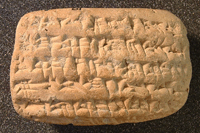
Tidskriften Archaeology har röstat fram de 10 mest betydelsefulla arkeologiska upptäckterna under 2007. Bland de 10 i topp finns Nebusarsekim kilskriftstavla, som jag själv har bloggat om här och här.
Verkligen roligt att denna upptäckt som bekräftar en historisk person i Bibeln, närmare bestämt i Jer 39:3, platsar i denna lista. Vad som gör upptäckten unik är att det är mycket ovanligt att en icke kunglig person i Bibeln omnämns i utombibliskt material.
Det kan vara värt att läsa lite om de andra 10 i topp upptäckterna också. Bli lite allmänbildad alltså. Archaeology presenterar också ytterligare nio viktiga fynd som har gjorts under 2007, men som inte riktigt tog sig in på 10 i topplistan.
Tack till min Tommy Wasserman på Örebro Teologiska Högskola för detta tips.
Virtuell Qumran modell

Bob Cargill har i ett spännande projekt digitalt rekonstruerat Qumran. Under SBL San Diego konferensen i november kunde man besöka en utställning om Dödahavsrullarna, och i samband med det visades en digitaliserad film om Qumran. Så här beskrivs filmen på bloggen Virtual Qumran:
The digital movie Ancient Qumran: A Virtual Reality Tour is nearing completion. The original, unpublished script is almost complete, and the high-definition graphics are re-rendered and optimized for viewing in HD. The movie is based upon the UCLA Qumran Visualization Project’s digital model of Qumran, and takes the viewer on a tour of the reconstructed settlement of Khirbet Qumran. It offers a history of the archaeological excavation of the site and the surrounding caves, and discusses the different theories concerning the nature and expansion of Qumran.
Denna film kan du efter 1 januari 2008 hämta hem till din hårddisk från hemsidan www.VirtualQumran.com. Där kan du läsa mer om projektet och bland annat se ett par YouTube trailers (även här och här). Detta lär bli ett fantastiskt pedagogiskt material för undervisning om Dödahavsrullarna och Qumran:
You’ll be able to navigate the reconstructed settlement from the comfort of your own home, office, or classroom.
Ser verkligen framemot detta! För de som inte kunde åka till USA för att besöka utställningen i San Diego Natural History Museum har snart möjlighet att se den omtalade filmen i sin egen dator.
Tack till Jim West på Biblical-Studies List för denna information. Se även Jims blogg om projektet.
Uppdatering om Nehemjas mur

För er som är intresserade av att följa de arkeologiska utgrävningarna av Davids stad i Jerusalem, har jag uppdaterat detta inlägg om upptäckten av vad som kan vara Nehemjas murar (se Nehemjas bok i Gamla testamentet).
Det är fortfarande osäkert hur allt det som har grävts fram skall tolkas och dateras, vilket också skapar osäkerhet om det verkligen är Nehemjas murar man har upptäckt. Men hebreiska universitetets arkeolog Dr. Eilat Mazar verkar säker på sin sak.
En annan mycket känd arkeolog, Israel Finkelstein, tycker att fynden i Davids stad är intressanta, men anser ändå att den upptäckta muren kan ha byggts senare än Nehemja.
Klicka här om du vill läsa mer. Om du följer länkarna i min uppdatering finner du mycket fina bilder på muren (som ex, den ovan).
Muslimer har erkänt judiska templets existens
I ett tidigare inlägg förklarade jag följande:
Den muslimska myndigheten (the Waqf), som idag kontrollerar tempelberget, förnekar att det har någonsin funnits ett judiskt tempel. Det som är Tempelberget för judarna är för muslimerna al-Haram al-Sharif (Noble Sanctuary) – den tredje heligaste platsen i muslimska världen. Arkeologin visar återigen att denna uppfattning (att det aldrig har historiskt existerat ett judiskt tempel i Jerusalem) inte grundar sig på fakta utan på religiös ideologi.
Detta är korrekt information utifrån den situation som existerar i Jerusalem idag. Det som borde läggas till är att även den nuvarande politiska situationen har orsakat låsningen. Men det har inte alltid varit så.
Det finns en officiell guide över tempelberget publicerad 1925, 1930 av den muslimska myndigheten (samma myndighet som förnekar det judiska templets existens idag) där tempelplatsen identifieras med Solomons tempel (det första judiska templet). Då var den politiska situationen annorlunda än vad den är idag. Läs mer om detta på Todd Bolens BiblePlaces Blog, där du också kan ladda hem guiden i pdf-format.
 Stefan Green